
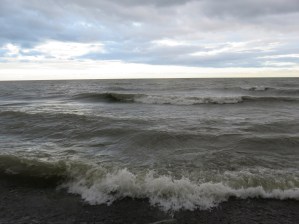
Kind of like the erosion of a shoreline, the Coronavirus keeps wearing people down. You could call it the erosion of hope.
Like for the people caught between Colombia and Venezuela — thousands who had evacuated the shambles of their homeland for the chance at a better life next door. Colombia! The land of promise and new beginnings! But Covid19 has put an end to all that — by destroying Colombia’s economy. So dashed are their hopes for a better life, that more than 80,000 Venezuelans file past Bucaramanga these days, pulling suitcases along the dusty road back to their homeland. And a more disillusioned wave of humanity you would never find. “Going back to Venezuela,” said one, “means that hope is over.”
Then there is the tragic story of Dr. Lorna Breen, who worked at New York Presbyterian Allen Hospital in Manhattan, where she supervised the emergency department. Week after week, “the unit had become a battleground, with supplies running out and the staff falling ill. The waiting room was overcrowded. The sick were dying unnoticed.” In the midst of it all, the doctor lost all hope and committed suicide. As Corina Knoll puts it in a tribute, “She was unflappable through every challenge until she faced this relentless killer” (NYT, July 25, 2020).
And how many businesses have suffered the fate of Harrell’s Department Store, which had been serving its North Carolina community for 117 years? When Harrell’s closed its doors for the last time in June, this was the commentary: “It has survived changing fashions, world wars, the Great Depression, the 2008 financial crisis, and floods. But it couldn’t survive the coronavirus.”
Such trying times bring to mind Old Testament Job and the erosion of hope. After losing pretty well everything in a series of tragic blows, Job cries out, “The waters wear away the stones; the torrents wash away the soil of the earth; so you destroy the hope of man” (Job 14:19). Such words of lost hope! The words of such a man, who has come to the end of his strength, “belong to the wind.” It is as the ancient proverb says: Gutta cavat lapidem non vi sed saepe cadendo — “Constant droppings will make a hole in flint.”
Sea wave erosion is like that with its hydraulic pressure, the impact of waves striking the shore, and the constant abrasion —wearing, grinding, or rubbing away by friction. Sand and pebbles, agitated incessantly by water, can break down chunks of shoreline and alter the seascape permanently. “Particles are dragged back and forth by wave action, abrading the bedrock along the coast and abrading each other, gradually wearing pebbles into sand … Wave erosion causes shorelines to retreat.”
But this erosion of hope — what kind of abrasion is this? When hope erodes, as William Hannan says, “all you can do is lie in bed and hope you fall asleep before you fall apart.” How do we rekindle hope during such times? It is almost as though this is beyond our human capacity, and that we need a special measure of divine grace.
Perhaps the best news for such times is that God’s grace also comes wave upon wave. As John’s gospel puts it, the divine supply in Jesus is so plentiful that “of his fulness have we all received, and grace upon grace” (1:16). The Greek phrase, charis anti charis can be translated “grace for grace” or, most preferred, “grace upon grace.” Thus when we think of the erosion of hope in coronavirus times, it provides a word of reassurance. We draw from the ocean of divine fullness grace upon grace—one wave of grace being constantly replaced by a fresh one. It is like a counter force to the erosion of hope!
In other words, as F. F. Bruce puts it, “There is no limit to the supply of grace which God has placed at our disposal.” It is like the clouds of Noah’s day that kept pouring out rain; the granaries in Joseph’s days that held endless reserves of grain; the rock in the wilderness that kept pouring out the water; or that wonderful cup of Psalm 23 — that keeps “running over.”
Alfred Lord Tennyson described the erosion of hope in a poem:
Break, break, break,
On thy cold gray stones, O Sea!
And I would that my tongue could utter
The thoughts that arise in me.
And as the poem continues, it carries a great sense of loss, and the feeling that all hopes have been eroded by the sea: And the stately ships go on To their haven under the hill;
But O for the touch of a vanish’d hand, And the sound of a voice that is still!
Break, break, break
At the foot of thy crags, O Sea!
But the tender grace of a day that is dead
Will never come back to me.
“Good times are dead, never to return.” Such is the erosion of hope that engulfs many people during our Coronavirus days.
But there is a much more hopeful song to be sung in such times. Written and sung by Gordon Jensen in the eighties, “Grace Upon Grace” seems especially destined for our viral days!
“Like the ocean in waves ever sweeping the shore,
For his children comes the grace of the Lord
And like the mighty sea so deep and so wide
His grace to us flows in an endless supply
“Grace upon grace, like the waves on the shore;
Always enough, always more.
Grace upon grace like the waves on the shore;
All that I need, is mine from the Lord.”
 JCK-at-large SITE
Leave a comment