
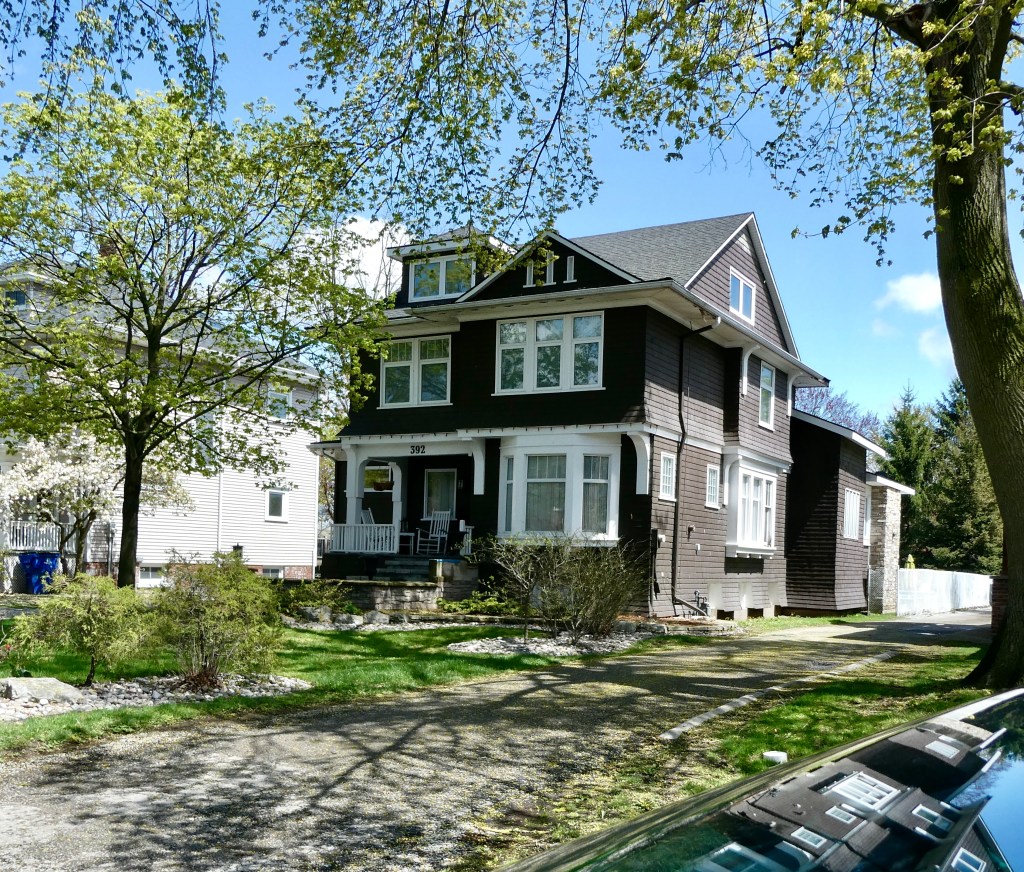
Sabrina Maddeaux, a newspaper columnist, warns that young Canadians are “furious” over the state of housing in Canada:
“One in three Liberal cabinet minsters supplement their salaries with rental or investment incomes. About 40 percent of all MPs do the same… Housing minister Ahmed Hussen now owns three rental properties. It’s no surprise so say young Canadians are not just frustrated but furious when it comes to housing. The dearth of reasonably priced homes is bad enough… but when elected leaders are perfectly content to reap the benefits of our pain, it is nothing short of enraging” (NP, May, 2023).
I mustered some mild indignation myself on a morning excursion around Newmarket. I came across a nice bungalow and decided to sample the market. We were staying over with relatives in one of the bedroom city’s leafy springtime suburbs. Behold, in the early morning mist, the only ‘For Sale’ sign I was to see all morning.
I called the agent later. This place struck me as the layout and age of a place one might like to buy, especially when “no more stairs” becomes a priority — as it has for most of my crowd. A walk in the morning is one thing: climbing stairs everyday in your house is something else.
“It’s sold,” the agent said.
“Oh, what was the asking price?”
“We listed at $989,000 and it sold for One point Four.”
“Is that like $1.4 million?” I expressed a little surprise — and I think the agent found my surprise surprising. I had the aged bungalow pegged at about 2,000 square feet, including an attached two-car garage. And it lay on a large corner lot in a pleasant, leafy neighbourhood which sloped down to the Tom Taylor trail. Here was an attraction for sure, a bike trail which could extend a morning bike ride along the Newmarket creek for 30 groomed miles through town and out to the fringes, coyotes and geese galore along the way.
Still, I was surprised at the price of the property. Of course, I had been out of the neighbourhood for a while, but I had this memory of my sister and her young family buying in that very zone for about $89,900 — and that didn’t seem so terribly long ago. Allowing for inflation, I had an ethereal vision of such a property selling for abound $200,000 — probably what it would have listed for in the year 2000. How could housing prices in Newmarket, Ontario, which is not exactly one of the world’s destination cities, be up fivefold in twenty years?
“Can you believe it?,” I griped over morning crepes. “A modest bungalow in your neighbourhood listing for nine-eighty-nine — and it sells for one point four! That must put this place,” — we sat around an island bar table in a glittering open concept kitchen — “with your two stories… close to two million!” We shook our septuagenarian heads and wondered aloud how it could possibly have come to this. We talked about kids and grandkids, downpayments and mortgages, about our first homes — a little circle of senior citizens with their morning coffee, recollecting better times for young homebuyers.
“What did you pay for this place?,” I asked, recalling the time when our host had moved to the GTA after he had landed an engineering job back in the eighties.
“One twenty-five,” he said, “and that was a lot of money! What about your first home?”
“Our first house was in Kingston Mills, 1972, just north of town. It went for a towering $18,000 dollars. And that was a lot of money at the time!”
“They say the cost of housing in Canada has increased by 300 percent since 2000.”
One thing was certain. We lived in a much kinder world back then, graduating and starting families. Even a basic nine-to-five job could get you into a home — with maybe a boat and cottage on the side. Why had life gotten so much more demanding? It’s not just finding the capital for a downpayment — which these days runs at twenty per-cent. It’s about servicing a big mortgage with the accompanying obligation to keep working indefinitely! As Paul Kershaw puts it, “In 1976 it took five years of full-time work to save a 20 per cent down payment. Now it takes seventeen years, and rents have been steadily rising.”
Imagine a young couple having to work for seventeen years just to put together a downpayment! And then, having to keep working forever to make the mortgage payments! It’s like their whole life is suddenly ‘built’ around keeping a roof overhead!
Not only that, but according to the CBC, households now owe more than Canada’s entire Gross Domestic Product: “Canadian households are more in debt than those in any other G7 country, and the amount they owe is now more than the value of the country’s entire economy… [which is] more at risk… Household debt now sits at 107 per cent of Canada’s GDP… and this will likely continue to increase unless we address affordability in the housing market.”
As for what to do about the problem, our table of Septos did not offer anything new: could we possibly reduce immigration, increase low-income housing, shift government priorities toward strengthening the overall economy? Our morning newspaper quoted mayoral candidate Olivia Chow advocating rent control — but these were seen as “old ideas!” “We know they always backfire… Landlords spend less on maintenance… Developers build fewer rental units… The result is to worsen the housing shortage!…. We need to do away with rent controls altogether.”
As for the GTHBI (the First Time Home Buyer Incentive), here was “a perfect example of the governments two-faced approach and lack of commitment to housing reform:
Doubling down and extending the program to May, 2025 is completely at odds with reality. Barely any first time buyer can afford to enter the market without rental help or an inheritance. The average price of a two bedroom condo in Toronto hovers around $1 million. Town homes even hours outside the core go for around that number, never mind anything detached. Finding even a small wartime bungalow under $1 million is all but unheard of.”
One thing most everyone agreed on was, unaffordable housing is built into the present Canadian economy. A full 13 percent of our national GDP is in Real Estate, a bigger sector than manufacturing or mining, bigger than oil and gas; bigger than construction, or even health care, financial services or all the other industries. Thus, property owners and landlords, which include most members of parliament, have a vested interest in keeping real estate prices high and escalating. While the national GDP grows at an anaemic 3.1 percent per year, the real estate sector consumes 30 percent of it.
Little wonder some handwringing economists are calling on the government to stop investing so much in real estate — by offering reduced down-payments to first time buyers and the like — and start investing seriously in manufacturing and engineering, in business enterprises which actually generate economic growth:
“Canada has been growing our economy by increasing the major cost of living, without generating jobs so that local earnings keep pace… Instead small numbers of Canadians (notably realtors) enjoy very large incomes in a way that drives wealth inequalities between owners and renters and between older and younger residents. All the while younger people and newcomers struggle to earn enough from full time work to pay for their primary cost of living — housing” (G&M, May 2023).
Hence the “fury!” And what about the communio sanctorum? As the nation begins to resemble the France of Louis XIV with its widening gulf between rich and poor, will a mild outrage arise from the hallowed halls of its church? Can we not at least state loudly that this is not the kind of society we want — a society which is losing its reputation as a promising and attractive democracy? Can we express some divine indignation over the disenfranchised homeless? Can we raise a united voice of protest against government policies that are broken and unjust? Can we give a fresh voice to the 8th Century prophets of Judah — who castigated real estate sin in the same breath as bribery, drunkenness and unbridled sexuality?
“Woe to those who add house to house and join field to field, until there is no more room, so that you have to live alone in the midst of the land! In my ears the Lord of hosts has sworn, ‘Surely many houses shall become desolate, even great and fine ones, without occupants” (Isaiah 5:8-9).
Christians for Social Action (CSA) shares some timely priorities:
- Community: Building, sustaining, and growing a community of collaborators is a fundamental way of doing justice work. Why? Because no one person or church, no single nonprofit or denomination, can touch make the widespread, systemic changes that are needed to upend injustice in this world. Community maximizes effectiveness.
- Holistic ministry: This models God’s concern for the total well-being of people and communities based on the full implications of the Gospel: that the good news of Jesus Christ is salvation for the whole person—body, mind, spirit, and social relationships—and for the whole of existence—creation, nations, and sociopolitical structures.
And what a timely objective! “To stir the imagination for a fuller expression of Christian faithfulness and a more just society.”
 JCK-at-large SITE
Leave a comment