
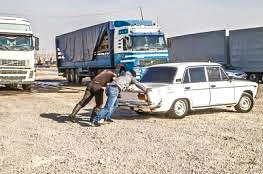
A couple of young guys were pushing their Corolla into a gas station, right up to the pump. I guess they had been on their way to refuel for Easter week-end and came up just short. Running on empty carries its risks!
But that’s not unusual in our town. Our taxis often live on the bottom of the tank. In fact, because they are always running on empty, their first stop when you jump in may well be the petrol station. As was the case with my last taxi ride.
“Just ten kwacha, Madala,” said Moses, pulling into the Total Service Station. “Then we go.” That’s less than a cappuccino worth of gas, but he’ll make fifty kwacha on the trip, so he can always add another cup of petrol later.
“You should not run your vehicle on empty,” I say. “The engine does not like it.” I add my theory on how all of the sediment in gasoline goes to the bottom where it lurks, waiting to do its nefarious work, much like cholesterol. It clogs up the flow and chokes performance. “You are much better to drive off the top of the tank.”
“Yes, Bashikulu, you are right.” Not that this ancient Corolla has ever been driven off the top of the tank!
“And you must never buy ‘changanya-fuel,’ I add, warming to the subject. “That petrol they sell along the road in those little jerry cans? It is contaminated and can destroy your engine.”
“Yes father, you are right.”
I pull out my fifty kwacha and I’m off — with the strongest suspicion that Moses’ Corolla will never see a full tank of petrol. Alas, it is condemned to a lifetime of living off the bottom of the tank.
But imagine such an existence! Always sucking sediment. Always wondering whether you have enough fuel to make it home. Never knowing when you may have to jump out and push.
And for what? There is no need to be running on empty. Once you garner enough kwacha to fill the tank, you simply refuel every quarter tank or so. You end up spending exactly the same amount on petrol, but you’re living off the top of the tank! Which is the only way to live.
Yet this is a human frailty, I fear, having lived off the bottom of the tank myself many a time. There are always better things to do than fill up with gas. During student days, we used to talk about “driving on fumes.” Even today, some of us like to live with the pleasant illusion that “we’ve got plenty of fuel” and there will “always be time” for a fill-up.
As with the Mukuba taxis, so with life. We can end up “running on empty” when fullness is “just a turn-in away.” In the words of the great apostle, “In Jesus dwells all the fullness of the Godhead bodily” (Col 2:9). Meaning that: a relationship with Jesus provides all the fullness that life will ever need. As Larry Norman used to sing in the seventies, “A lifetime filled with Jesus is like a street that never ends.”
So why drive the streets of life on anything less? The apostle was was writing to people who were filling up with Changanya fuel… falling into the “Colossian heresy” which dumped a lot of sediment into their spiritual life: things like “touch not, taste,not, handle not” — ascetic practices which Paul says were destined to “perish with the use.” Not only were these not enhancing performance, they were filling lives with sludge. “Why do you consent to such things,” he asks, “when fullness is found in Jesus?”
“These are a shadow of the things to come, but the substance belongs to Christ.
Let no one disqualify you, insisting on asceticism and worship of angels, going
on in detail about visions, puffed up without reason by his sensuous mind, and not
holding fast to the Head, from whom the whole body is nourished, knit together…
and growing… (2:17-19).
We might wonder if Paul had in mind the feeding of the multitude when he talked about fullness:
“Jesus then took the loaves, and when he had given thanks,
he distributed them to those who were seated. So also the fish,
as much as they wanted. And when they had eaten their fill,
he told his disciples, “Gather up the leftover fragments,
that nothing may be lost” (John 6:11-12).
Here is a multitude that had “eaten their fill”… “all ate and were satisfied.” According to Donald Carson, “John stresses the lavishness of the supply: the people ate as much as they wanted, far outstripping the titbit that even two hundred denarii would have failed to supply. So also the true bread from heaven who gives life to the world far outstrips the manna in the desert…. All are satisfied; all had enough to eat. John portrays this as the ample provision of the Lord who declares, ‘My people will be filled with my bounty’” (Jer 31:14).
More language of fullness comes from the lips of the Saviour to the crowd:
“My Father gives you the true bread from heaven. For the bread of God is he who comes down from heaven and gives life to the world.” They said to him, “Sir, give us this bread always.” Jesus said to them, “I am the bread of life; whoever comes to me shall not hunger, and whoever believes in me shall never thirst” (John 6:32-35).
Carson traces the thought something like this: “the manna God provided through Moses is not the true bread from heaven, nor is the Torah God sent through Moses the true Torah… The true bread from heaven, the true Torah, is Jesus himself…. So the hungry and thirsty person who comes to Jesus finds his hunger satisfied and her thirst quenched. This does not mean there is no need for continued dependence upon him for continued feeding upon him; it does mean there is no longer the core emptiness that the initial encounter with Jesus has met. The consummating satiation comes with the final oracle: ‘Never again will they hunger; never again will they thirst’ (Rev 7:14-16).
Ah, life off the top of the tank! Imagine living out the wonderful unfailing promises of scripture: “fullness of joy;” “being filled with the Spirit;” “my cup overflows!” All these and many more are ours, for the simple act of “turning in.”
And of course, in the Spirit of Easter Sunday, they all begin with Jesus.


Leave a Reply